Respiratory / VISUAL EXPLAINER
How Oxygen Crosses From Air Into Blood
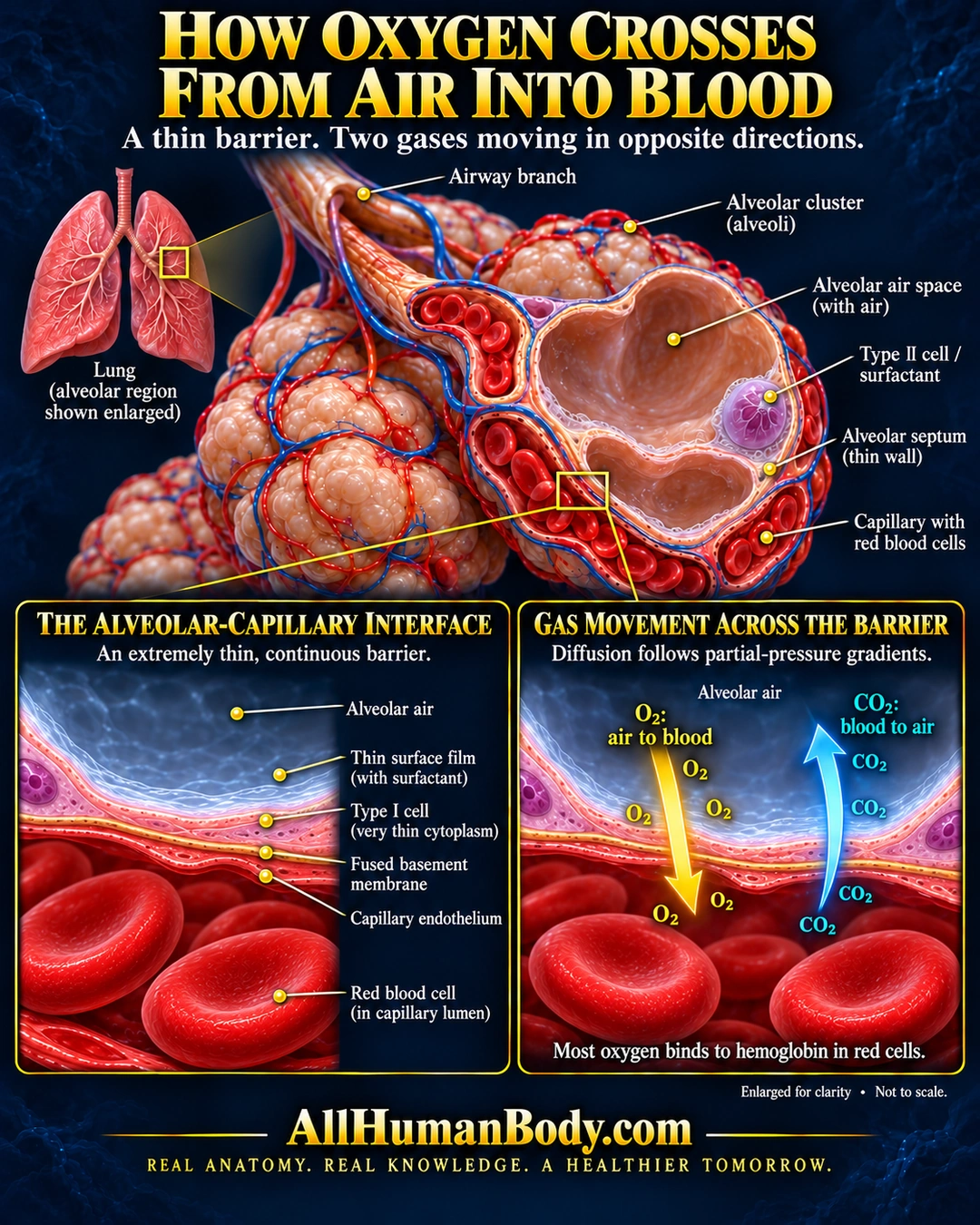
Alveolar air and blood remain separated by a thin tissue barrier. Oxygen and carbon dioxide diffuse across it in opposite directions according to their own partial-pressure gradients; most blood oxygen is carried on hemoglobin.
READ THE IMAGE
What the illustration shows
Anatomy poster titled “How Oxygen Crosses From Air Into Blood.” A small lung illustration locates an enlarged cluster of alveoli. An open alveolus shows its air space, a wall-attached Type II cell associated with surfactant, thin septum and surrounding capillaries containing red blood cells. The left inset labels the surface film, Type I epithelial cell, fused basement membrane and capillary endothelium separating alveolar air from blood. The right inset shows a gold O2 arrow moving from air into blood and a cyan CO2 arrow moving from blood into air. Text explains that diffusion follows partial-pressure gradients and most oxygen binds to hemoglobin in red cells. Structures are enlarged for clarity and not to scale. AllHumanBody.com branding appears below.
How to interpret this poster
- Layer thicknesses, surface film and cell shapes are enlarged and stylized, not measured ultrastructure.
- This describes normal qualitative exchange, not oxygen targets, treatment or a guarantee of complete oxygenation.
- AI-assisted educational illustration; not physician certification, microscopy, a diagnosis or individualized medical advice.
- Fine annotations need enlargement; the full description provides an accessible text alternative.
AI-assisted educational illustration, adapted into web-sized images without changing its composition. This is general education, not an individual diagnosis or treatment recommendation.
EVIDENCE / CONTEXT
Sources and what they support
- How the Lungs Work: The Respiratory System ↗
Alveoli, surrounding capillaries and opposite oxygen/carbon-dioxide exchange directions.
- Anatomy and Physiology 2e: 22.1 Organs and Structures of the Respiratory System ↗
Type I epithelium, type II surfactant secretion and respiratory-membrane organization.
- Anatomy and Physiology 2e: 22.4 Gas Exchange ↗
Partial-pressure gradients and oxygen carried by hemoglobin in red blood cells.