Special Senses / VISUAL EXPLAINER
Why Do You Feel Dizzy After Spinning?
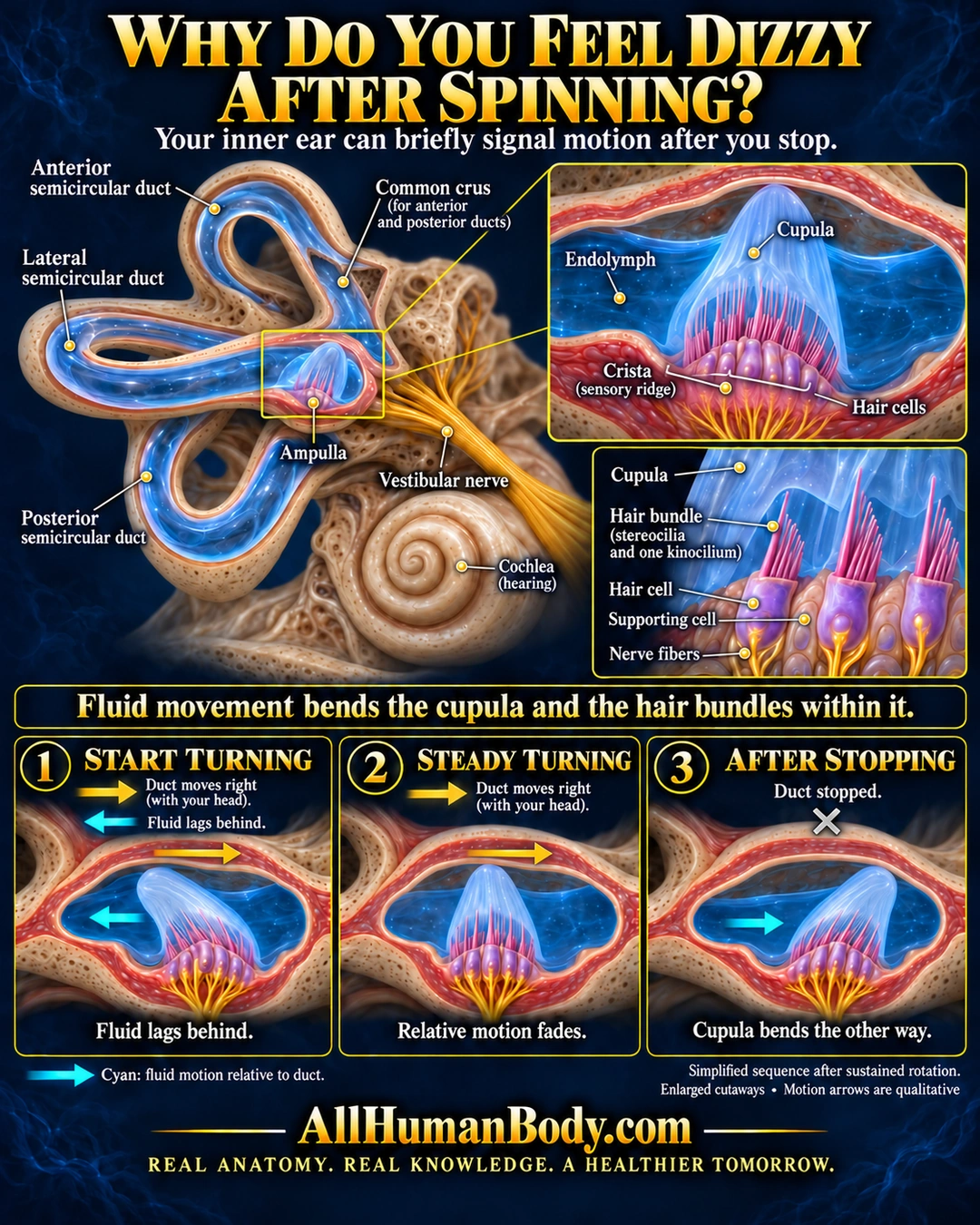
Changing rotation shifts fluid relative to the semicircular ducts and bends sensory hair bundles. After sustained turning stops, a temporary opposite response can contribute to feeling motion while still.
READ THE IMAGE
What the illustration shows
Medical illustration titled “Why Do You Feel Dizzy After Spinning?” A cutaway inner ear shows three semicircular ducts, an enlarged ampulla, and vestibular nerve. Magnified views show hair-cell bundles embedded in the gelatinous cupula above a sensory ridge, with supporting cells and basal nerve fibers. Three matched panels show the mechanism: when turning starts, fluid lags relative to the duct and the cupula bends left; during sustained steady turning, relative motion fades and it returns toward upright; after stopping, relative fluid motion reverses and the cupula bends right. These temporary signals can make you feel motion after you stop. Arrows indicate qualitative fluid motion relative to the duct. AllHumanBody.com.
How to interpret this poster
- A qualitative response after sustained rotation is shown, not an exact time course or a complete explanation of dizziness.
- The posterior duct is partly hidden; the image is not a complete three-dimensional labyrinth map.
- Arrows describe motion relative to the duct, not measured flow speeds.
- AI-assisted educational illustration; not physician certification, microscopy, a diagnosis or individualized medical advice.
- Fine annotations need enlargement; the full description provides an accessible text alternative.
AI-assisted educational illustration, adapted into web-sized images without changing its composition. This is general education, not an individual diagnosis or treatment recommendation.
EVIDENCE / CONTEXT
Sources and what they support
- Balance Disorders ↗
Fluid-filled semicircular ducts, cupulae, hair bundles and multisensory balance.
- Vestibular System: Structure and Function ↗
Relative endolymph motion, cupula deformation and sensory responses to rotation.