Special Senses / VISUAL EXPLAINER
Why Does Food Lose Flavor When Your Nose Is Blocked?
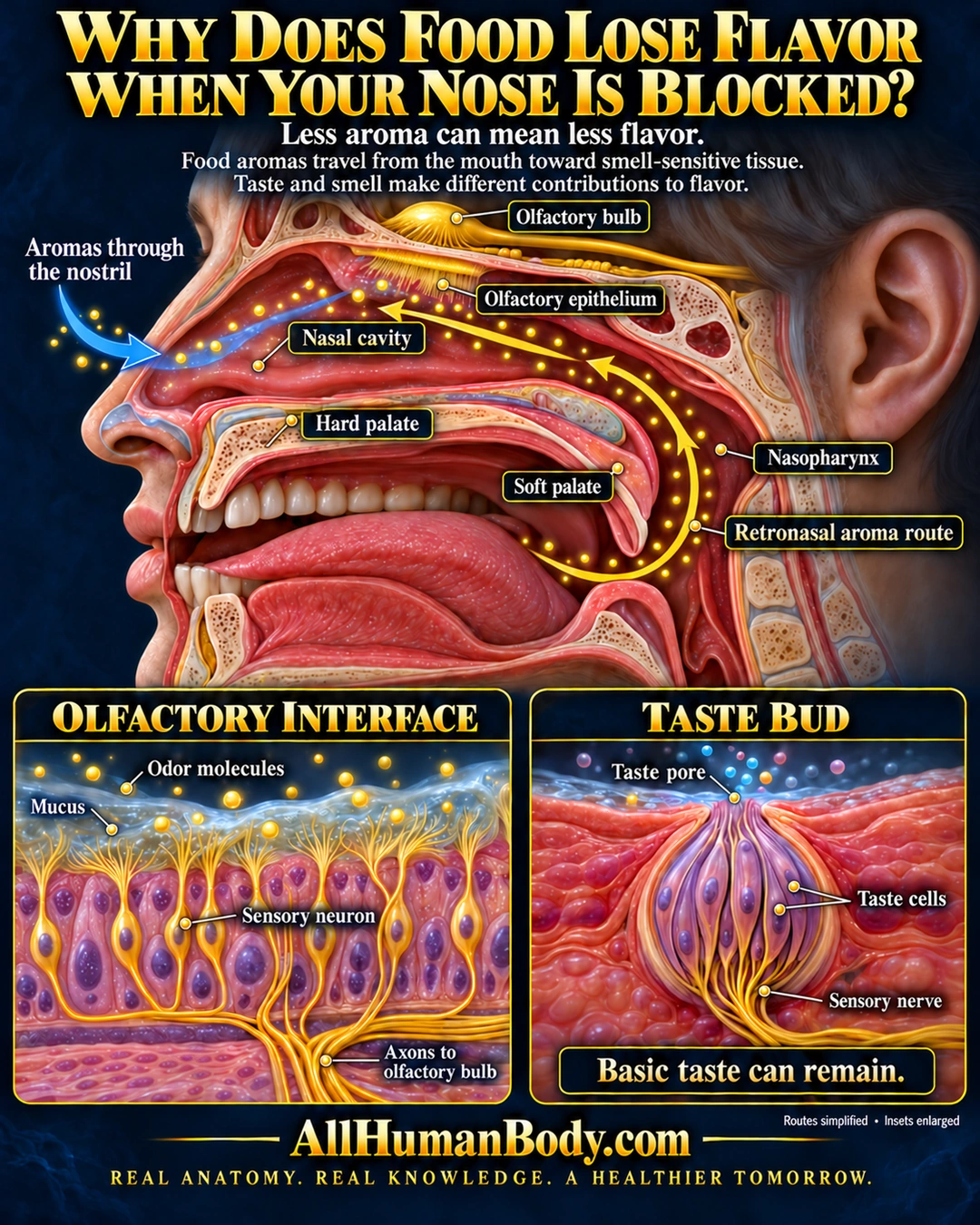
Food aromas can reach smell-sensitive tissue through the mouth and upper throat. A blocked nose can reduce this contribution to flavor even when basic taste remains.
READ THE IMAGE
What the illustration shows
Navy-and-gold anatomy poster titled “Why Does Food Lose Flavor When Your Nose Is Blocked?” A side cutaway of the head shows gold aroma arrows traveling from the mouth behind the soft palate, up through the nasopharynx and forward through the nasal cavity toward olfactory tissue high in the nose. A blue arrow shows aromas entering through the nostril. Labels identify the hard and soft palates, nasal cavity, nasopharynx, olfactory epithelium and olfactory bulb. Two lower insets depict an enlarged olfactory sensory interface with odor molecules, mucus, receptor neurons and nerve fibers, and a taste bud with a taste pore, taste cells and sensory nerve. Text reads “Less aroma can mean less flavor” and “Basic taste can remain.” Footer: AllHumanBody.com. REAL ANATOMY. REAL KNOWLEDGE. A HEALTHIER TOMORROW.
How to interpret this poster
- This illustrates reduced aroma delivery, not every cause of smell or taste change.
- Cell boundaries and olfactory cilia are stylized; this is not validated microscopic anatomy.
- The poster shows the route rather than a measured blocked-versus-unblocked comparison.
- AI-assisted educational illustration; not physician certification, microscopy, a diagnosis or individualized medical advice.
- Fine annotations need enlargement; the full description provides an accessible text alternative.
AI-assisted educational illustration, adapted into web-sized images without changing its composition. This is general education, not an individual diagnosis or treatment recommendation.
EVIDENCE / CONTEXT
Sources and what they support
- Smell Disorders ↗
Two odor-delivery routes and how nasal obstruction can reduce aroma access.
- Taste Disorders ↗
Taste and smell make distinct contributions to flavor; smell loss need not eliminate basic taste.
- Anatomy and Physiology 2e: 14.1 Sensory Perception ↗
Basic olfactory and taste-bud organization; no claim of exact cellular geometry.