Special Senses / VISUAL EXPLAINER
Why Does Your Nose Run When You Cry?
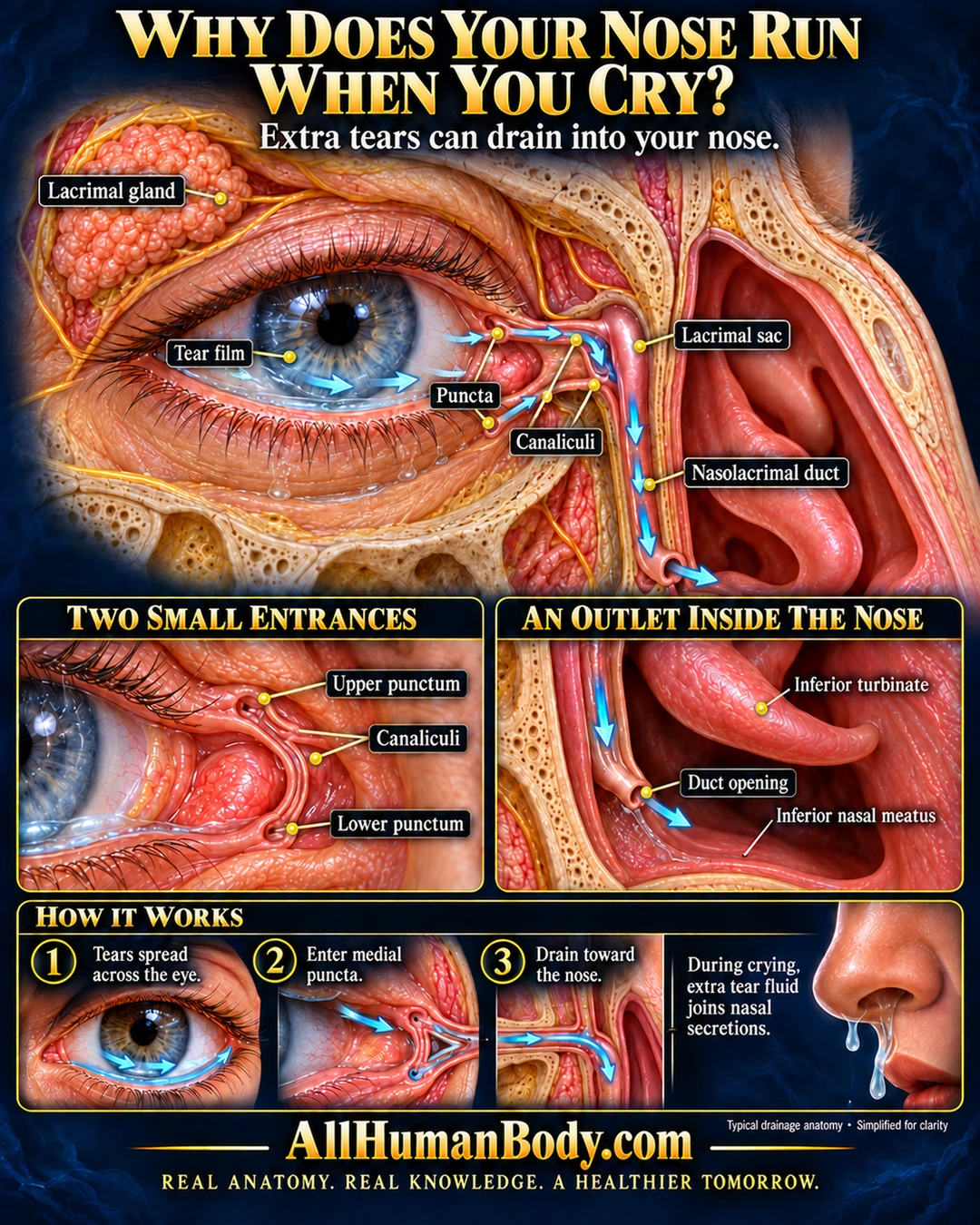
Tears spread over the eye and drain through small openings near the inner eyelids. Extra tear fluid during crying can follow this route into the nose and contribute to a runny nose.
READ THE IMAGE
What the illustration shows
Medical-style illustrated poster titled “Why does your nose run when you cry?” The subtitle reads, “Extra tears can drain into your nose.” An eye and adjacent nasal cutaway show the lacrimal gland above the outer side of the eye and the tear film on its surface. Blue arrows move toward two small openings at the inner upper and lower eyelid margins, labeled puncta. Separate canaliculi carry the flow toward the lacrimal sac; a continuous nasolacrimal duct descends and opens into the nasal space beneath the lowest turbinate. One enlarged inset identifies the upper punctum, lower punctum, and canaliculi. Another labels the inferior turbinate, duct opening, and inferior nasal meatus beneath it, with an arrow exiting the duct. A three-step strip says tears spread across the eye, enter medial puncta, and drain toward the nose. Beside a dripping nose, text explains that during crying extra tear fluid joins nasal secretions. Footer: AllHumanBody.com. The illustration notes that typical drainage anatomy is simplified for clarity.
How to interpret this poster
- A representative drainage route is shown; individual anatomy and drainage mechanics vary.
- Tear drainage can contribute to nasal running, but is not the explanation for every nasal symptom.
- AI-assisted educational illustration; not physician certification, microscopy, a diagnosis or individualized medical advice.
- Fine annotations need enlargement; the full description provides an accessible text alternative.
AI-assisted educational illustration, adapted into web-sized images without changing its composition. This is general education, not an individual diagnosis or treatment recommendation.
EVIDENCE / CONTEXT
Sources and what they support
- How Tears Work ↗
Distribution of tears over the eye and drainage toward the nose.
- Diagnostic imaging of the nasolacrimal drainage system. Part I. Radiological anatomy of lacrimal pathways. Physiology of tear secretion and tear outflow ↗
Lacrimal drainage structures and the outlet beneath the inferior nasal turbinate.