Respiratory / VISUAL EXPLAINER
Why Do You Get Hiccups?
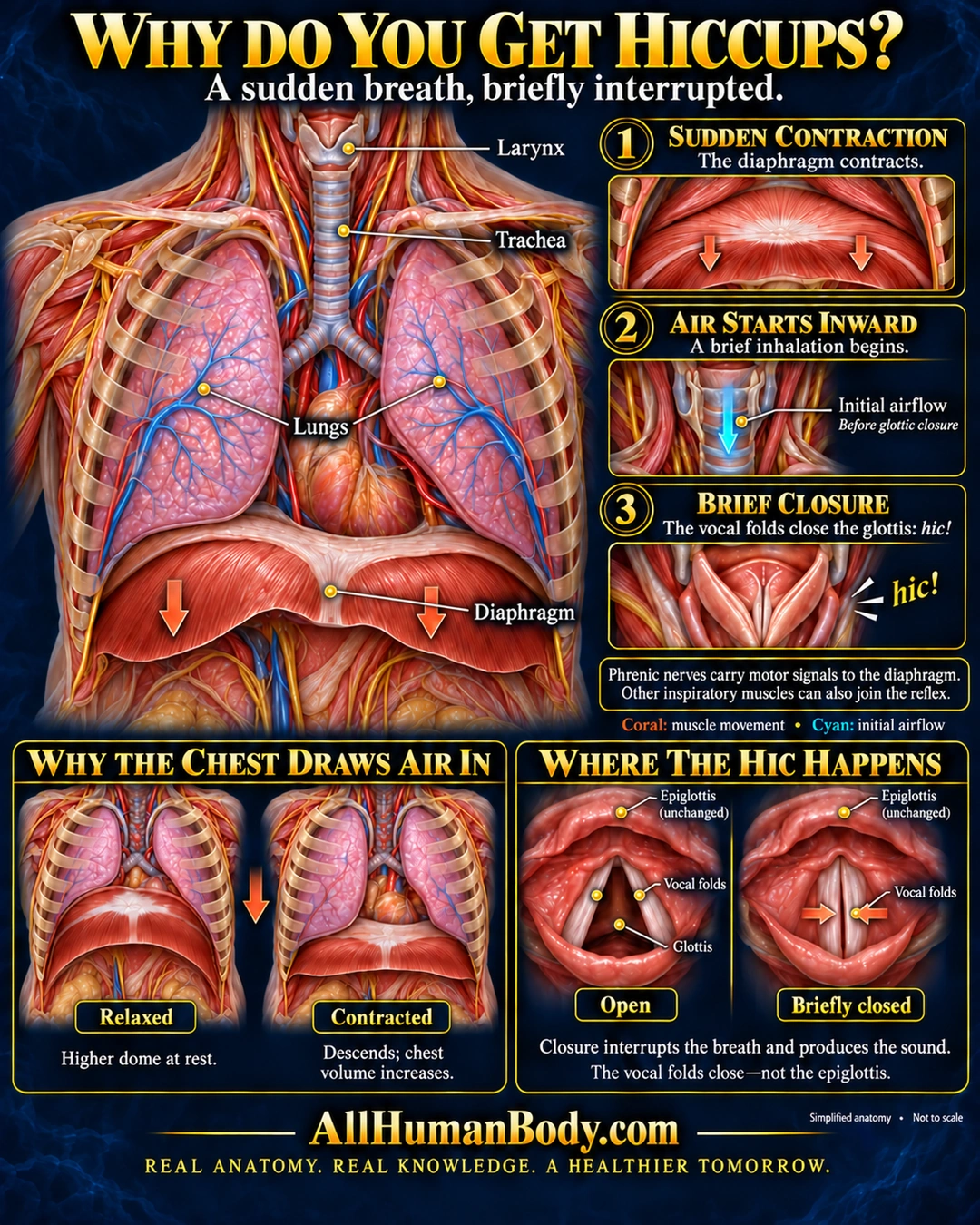
A hiccup begins with an involuntary inspiratory contraction. The vocal folds then briefly close the glottis, interrupting the breath and producing the familiar sound.
READ THE IMAGE
What the illustration shows
Gold-on-navy medical poster titled “Why Do You Get Hiccups? A sudden breath, briefly interrupted.” A front cutaway of the chest labels the larynx, trachea, lungs and dome-shaped diaphragm. Coral arrows point downward from the diaphragm. Three numbered panels show: 1, sudden diaphragm contraction; 2, initial inward airflow, shown by a cyan downward arrow in the trachea before glottic closure; and 3, brief vocal-fold closure producing the “hic” sound. Text notes that phrenic nerves carry motor signals to the diaphragm and other inspiratory muscles can join the reflex. A lower comparison shows a higher relaxed diaphragm dome versus a lower contracted dome as chest volume increases. Beside it, matching views of the larynx show an open glottis and vocal folds brought together; inward arrows indicate closure while the epiglottis remains unchanged. The caption explains that vocal-fold closure interrupts the breath and produces the sound. Footer: AllHumanBody.com. REAL ANATOMY. REAL KNOWLEDGE. A HEALTHIER TOMORROW. Simplified anatomy; not to scale.
How to interpret this poster
- The sequence is simplified; it does not explain every trigger or all central reflex circuitry.
- Detailed laryngeal, vascular and nerve anatomy is stylized, not a clinical reconstruction.
- The linked breathing lesson supplies foundations rather than a dedicated explanation of hiccups.
- AI-assisted educational illustration; not physician certification, microscopy, a diagnosis or individualized medical advice.
- Fine annotations need enlargement; the full description provides an accessible text alternative.
AI-assisted educational illustration, adapted into web-sized images without changing its composition. This is general education, not an individual diagnosis or treatment recommendation.
EVIDENCE / CONTEXT
Sources and what they support
- NLM MeSH: Hiccup ↗
Diaphragm spasm followed by inspiration and rapid glottic closure.
- What puts the 'Hic' into Hiccups? ↗
A single-adult observation of glottic closure; not proof of every hiccup or of a remedy.
- Anatomy and Physiology 2e: 22.3 The Process of Breathing ↗
Normal diaphragm contraction, inspiratory mechanics and motor control; not a complete hiccup circuit.